


Patents


Why 2025 was a record-breaking year for UK patent filings
March 02, 2026
UK patent filings shot up in 2025 compared to previous years. We wondered whether this was driven by individuals filing applications themselves, perhaps with a bit of help from AI? So, we filed a Freedom of Information request at the UKIPO, and the data we received in response was very insightful!
UKIPO filing trends
The UK Intellectual Property Office (UKIPO) publishes monthly statistics on patent, trade mark, and design applications.
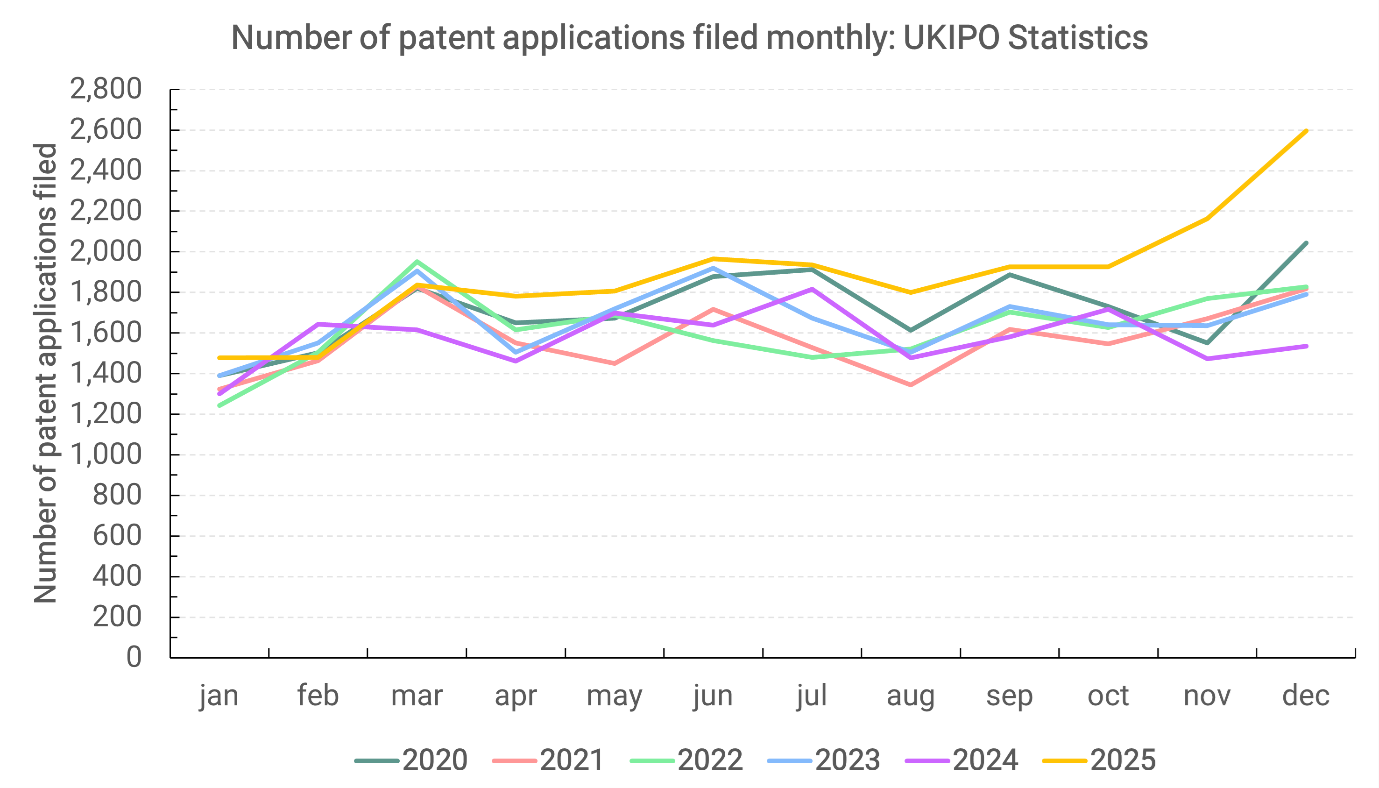
The above illustrates the number of patent applications filed monthly in previous years from January 2020 to December 2025.
What does this show?
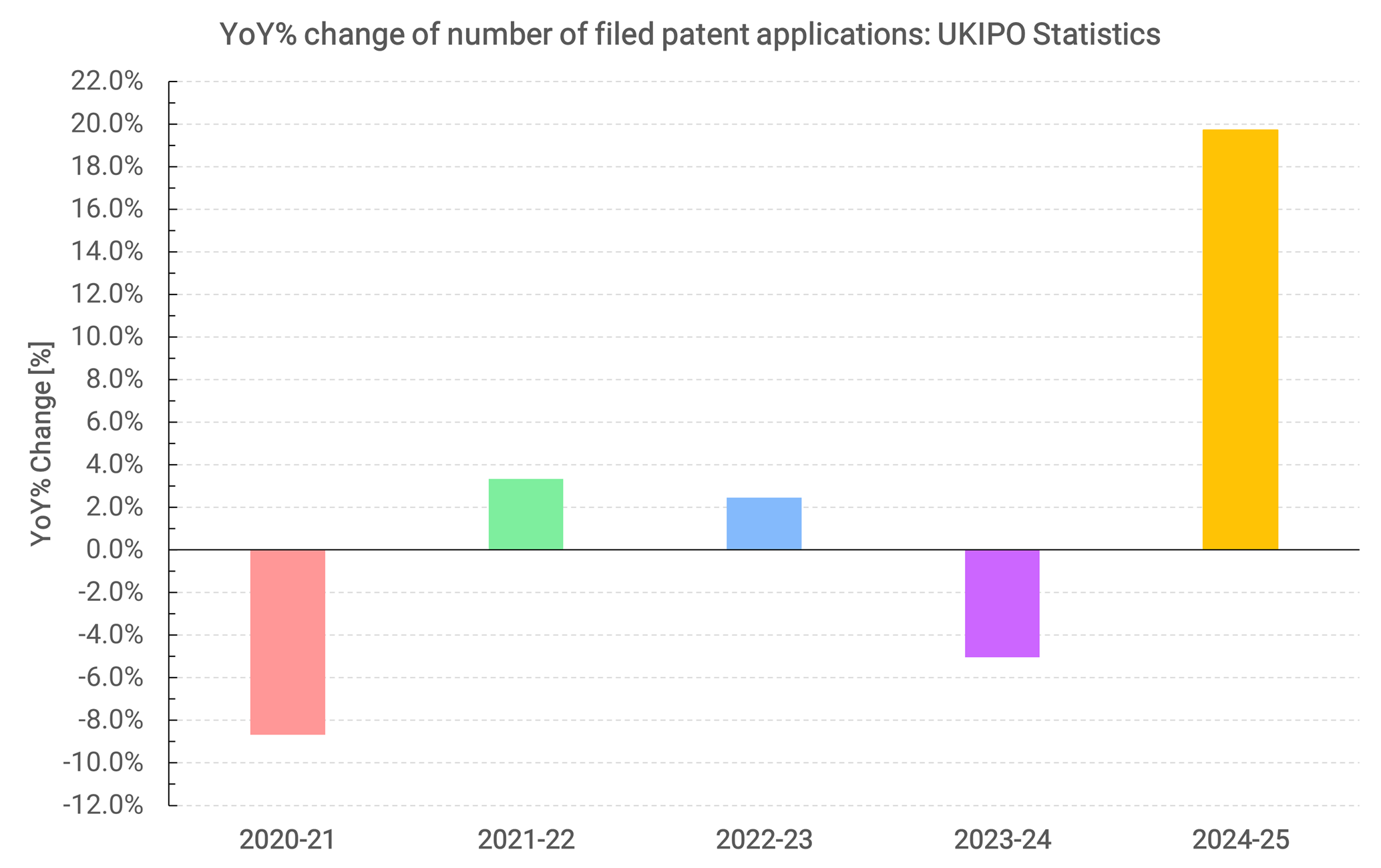
As shown in the above plot, the number of patent applications filed year on year (YoY) has surged in 2025 when compared to previous years.
The sharp drop in the period 2020–21 is likely a result of the COVID‑19 pandemic, which unsurprisingly disrupted research activity, commercial investment, and therefore filing behaviour across the IP sector.
Who is filing more patent applications?
Broadly, UK patent applications can be filed by anyone. When a UK patent application is filed, the UKIPO determines whether the applicant is represented by an agent or not, because this affects how the UKIPO communicates with the applicant. Applications filed by in-house agents count as represented.
The UKIPO only publishes headline filing figures, without any breakdown for represented and non-represented applicants. By filing a Freedom of Information (FOI) request, we were able to obtain this breakdown and publish our analysis below.
FOI release from the UKIPO
In response to our FOI request, the UKIPO provided information further dividing the above patent applications into those filed with or without attorney representation. The data will be published on the UKIPO website shortly.
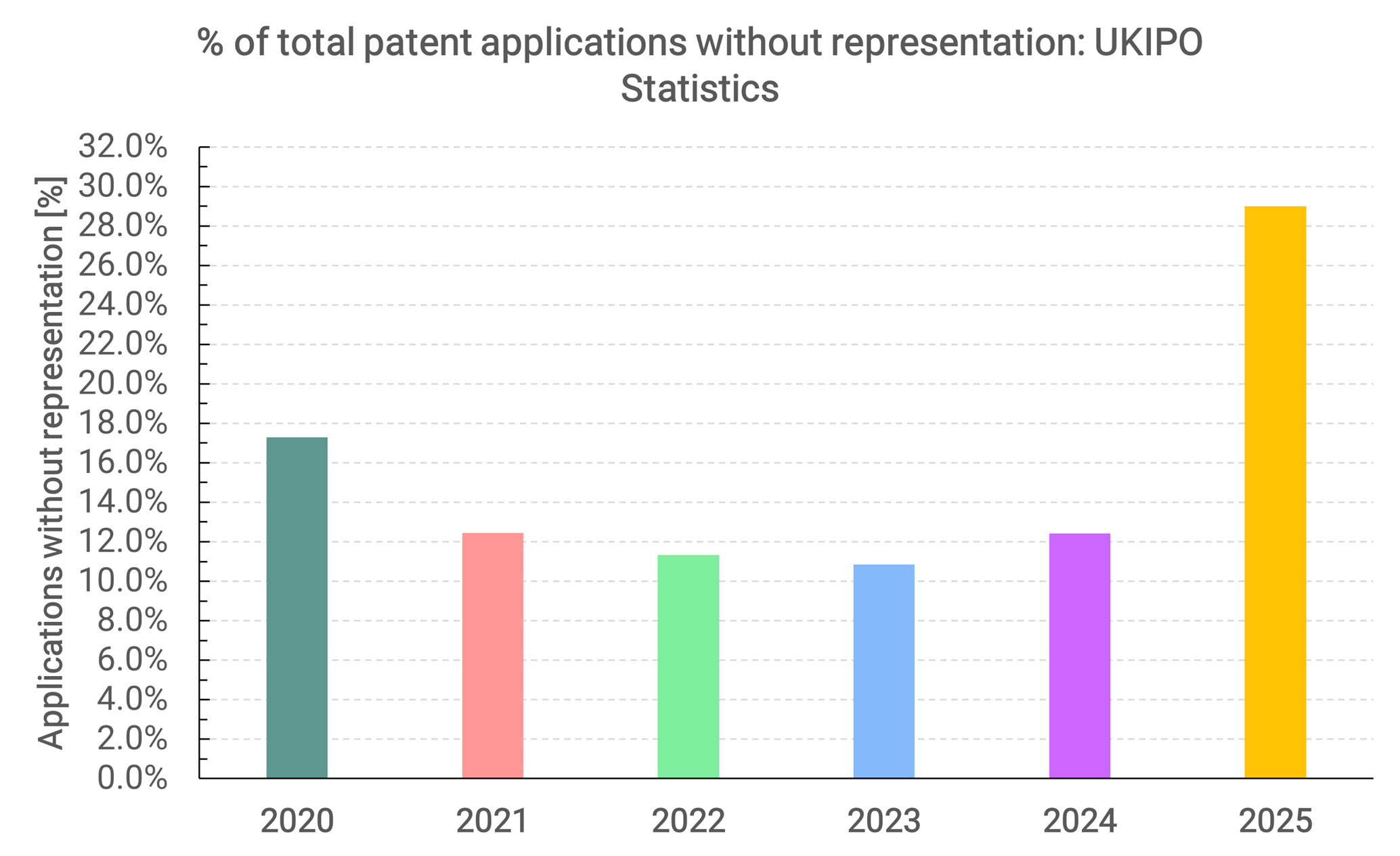
The above plot reveals how the proportion of applications filed without/with attorney representation has shifted in previous years. As shown above, the ratio of non-represented to represented filings more than doubled from 12.4% of all UK patent filings in 2024 to 29% in 2025.
The raw numbers show that after several years of declining non-represented filings, 2024 (2,354 filings) was up 9% on 2023 (2,165 filings), then 2025 (6,581 filings) was up 260% on 2024!
By contrast, represented filings were generally static throughout the whole six-year period. In fact, represented filings declined by 3% in 2025 (16,113 filings) compared to 2024 (16,602 filings). Therefore, 2025’s increase has been entirely driven by self-represented filers.
The monthly data
Examining the monthly data more closely shows that this proportion was not driven by consistently high levels throughout the year. In fact, the early months of 2025 were broadly in line with previous years, but the proportion of self-represented filings grew steadily throughout the year, peaking in December. This suggests that 2025 may not represent a peak, but rather a point in an ongoing upward trend. If the trajectory observed in late 2025 continues, the proportion of applications filed without representation could rise even further in 2026.
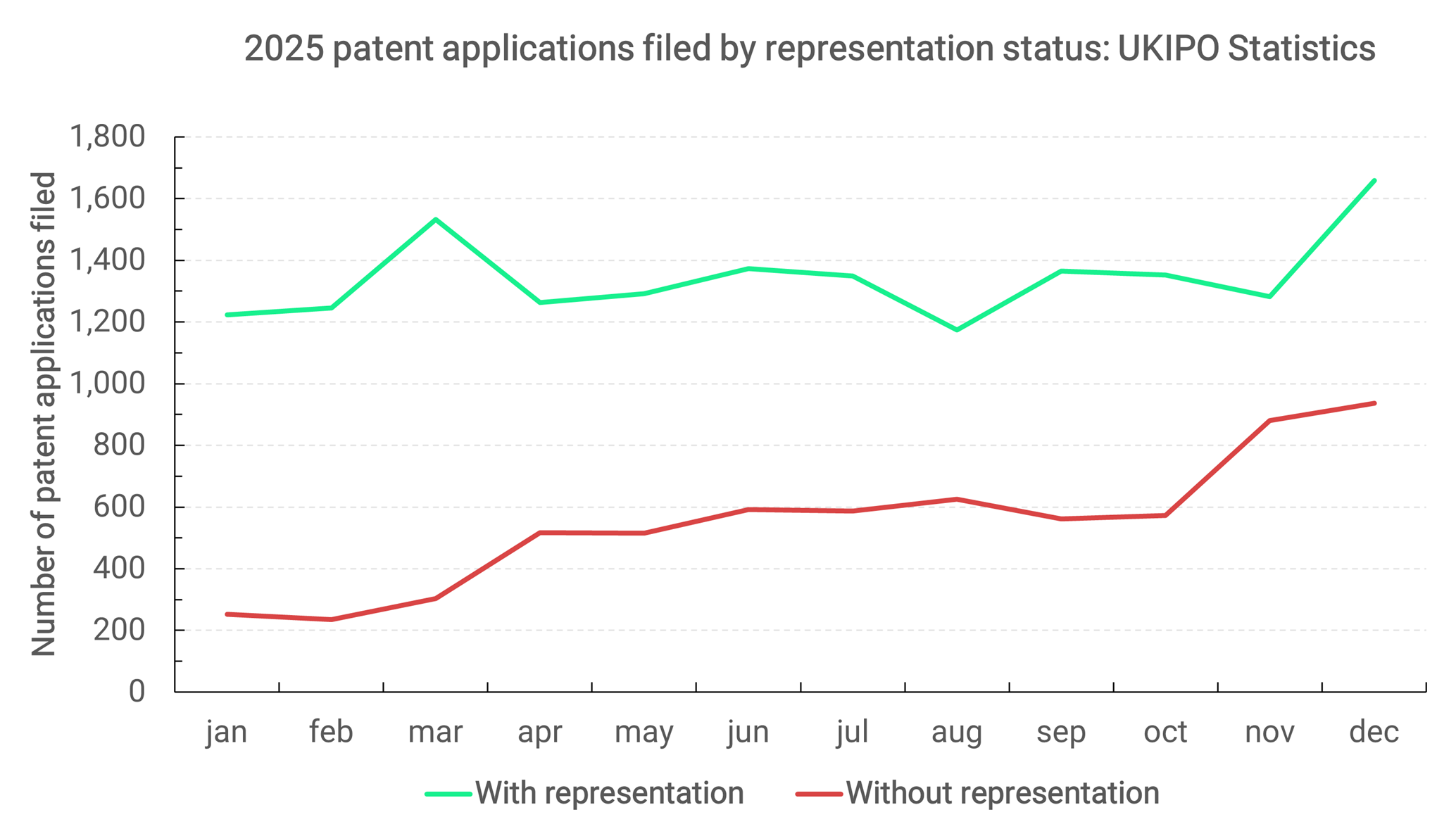
Filings with representation remained broadly stable over the year, showing a slight upwards trend. If this trend continues, we are not expecting to see a decline in represented filings in 2026.
In conclusion, the growth in unrepresented applications does not appear to be coming at the expense of patent attorneys. Rather, the data indicates that new applicants are entering the patent system – i.e., those who may not previously have filed a patent application at all. The expansion therefore appears to be additive rather than substitutive.
Supporting evidence from the Australian Patent Office
This pattern is not limited to UK shores; figures published by the Australian Patent Office similarly indicate a marked increase in self-filed applications (i.e., those without attorney representation). As referenced in this Patentology blog, during the first ten months of 2025:
- the number of self-filed standard patent applications rose by 82%; and
- the number of self-filed provisional applications rose by 174%
when compared with the previous five years’ average.
Notably, the Australian data also indicates that this growth in self-filed applications has not been accompanied by a corresponding decline in attorney-filed applications. This mirrors the position now evidenced by the UKIPO FOI data: the rise in unrepresented filings appears to reflect new entrants to the patent system, rather than a transfer of work away from patent attorneys.
Is the availability of GenAI tools responsible?
It is hypothesised that new entrants to the patent system are increasingly filing applications drafted with the assistance of Large Language Models (LLMs) such as OpenAI ChatGPT™, Anthropic Claude™, Google Gemini™, Microsoft CoPilot™, or DeepSeek™. However, it is very difficult to statistically prove whether, or to what extent, filings have been drafted with the use of LLM tools.
Anecdotally, our firm has seen a significant increase in enquiries from applicants seeking help after they used an LLM tool to draft their patent application. This increase corresponds to the trends shown earlier in this article.
The exponential growth in non-represented filings corresponds with the exponential growth in daily active users of LLM tools. For example, we found a strong 92% correlation between the number of non-represented UK filings and the number of weekly active users of the world’s most-used LLM tool (ChatGPT), for the period November 2023 to July 2025 (OpenAI statistics). Correlation does not equal causation, but it certainly matches what we have seen ‘on the ground’. Therefore, the number of self-filings may further increase if the number of weekly active LLM users further increases.
What will happen to these self-filed patent applications?
According to another FOI release by the UKIPO, the success rate of non-represented applications is routinely less than 6%. By contrast, most attorney-drafted applications succeed.
As part of the UKIPO’s FOI release, they informed us how many applications were filed with a search request, based on the presumption that applications filed with a search request better reflect an applicant’s intention to progress the application. The FOI data shows that most of the self-represented applications in 2025 were filed without a search request. In fact, the proportion of self-filed applications with a search request in 2025 (25%) slightly fell compared to 2024 (27.5%). Therefore, we do not predict an increase in the number of applications being progressed to the search stage or beyond.
Those who ask for help from patent attorneys as soon as possible are more likely to succeed, especially if they haven’t yet disclosed their invention to the public. Helping usually requires at least some re-drafting. Re-drafting requires re-filing and therefore losing the original filing date. Therefore, our ability to help usually requires the invention to not have been publicly disclosed.
Concerns
Many applicants mistakenly assume that they can file a rough disclosure with the help of an LLM, then publicly disclose the invention, and then get it professionally drafted later while keeping the original filing date. Such a strategy is possible in the USA but unfortunately impossible in the UK. Any re-drafting would require re-filing, which would change the filing date to a date after the applicant publicly disclosed the invention, therefore invalidating the application. Therefore, UK applications have to be drafted right first time.
Some applicants assume that LLMs are capable of drafting professional-quality patent applications, so that an attorney is never needed. This is also incorrect and leads to omission of essential technical detail.
Whether LLMs are used or not, poorly optimised patent applications often provide weak or unduly narrow protection, leaving inventions vulnerable to circumvention or easy workarounds. This creates substantial commercial risk: even if a patent is ultimately granted, enforcing a potentially infringed patent can require significant legal expenditure, and the potential licensing or revenue from a patent with an unnecessarily narrow scope may not justify those costs.
The increasing use of genAI in patent drafting will also undoubtedly place additional pressure on patent offices. A surge in filings inevitably increases the workload for examiners and may contribute to longer examination timelines overall.
Finally, the use of genAI raises concerns around confidentiality and the subsequent patentability of an invention. Drafting a patent application requires disclosing sensitive details of an invention, and submitting this information to an AI model may compromise confidentiality if that AI model is allowed to train itself on user inputs. This creates potential risks to the novelty of the invention and, ultimately, to the enforceability of any resulting patent rights.
Concluding remarks
If you have self-filed an application, with or without help from genAI, please get in touch with us as soon as possible. If you get in touch with us before publicly disclosing your invention, we may be able to fully optimise the application. If you have publicly disclosed your invention, we may be able to help but our options may be more limited.

Dan Hanna
Patent Advisor